

Pervaziv AI Introduces Cortex 5.0, Advancing Model Independence with Cortex-LLM-1.0 for Secure Software Development
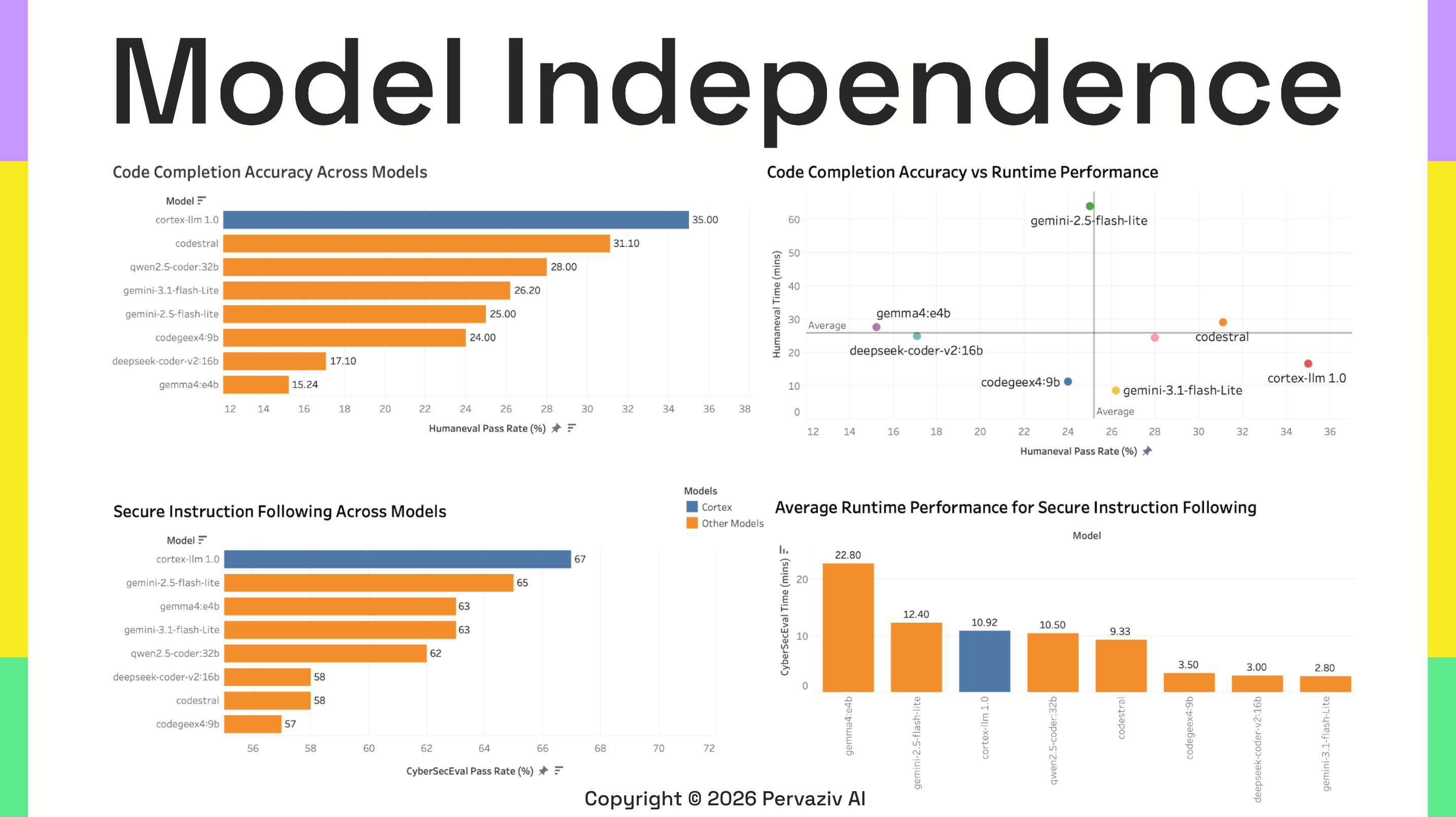
Cortex LLM 1.0 Model Comparison

New release introduces Pervaziv AI’s first internally trained AI model, strengthening specialized security analysis, remediation workflows, structured outputs.
SAN FRANCISCO, CA, UNITED STATES, July 1, 2026 /EINPresswire.com/ -- Pervaziv AI today announced Cortex 5.0, a major advancement in its Enterprise AI Control Layer for secure software development, AI assisted engineering, cybersecurity automation, and DevSecOps workflows. The release introduces Cortex-LLM-1.0, the company’s first internally trained AI model, designed to support specialized AI behavior for security analysis and security remediation inside real engineering environments.
Cortex 5.0 marks a significant step in Pervaziv AI’s movement toward model independence. As enterprises adopt AI across coding, security, cloud operations, and software delivery, organizations increasingly need more than access to powerful general purpose models. They need specialized behavior, structured outputs, governed workflows, predictable performance, lower false positives, and security-aware remediation that fits how software teams actually work.
Cortex-LLM-1.0 is designed around that need.
The new model brings together two complementary capabilities. The first is focused on security analysis, helping review selected code context and produce structured findings that can be consumed by downstream systems. The second is focused on security remediation, helping convert a validated issue into a practical, targeted code change.
Together, these capabilities support a closed-loop secure development workflow: analyze code, validate findings, recommend action, apply fixes, and re-check results. This represents a deeper evolution of Cortex from AI coding assistance into a more complete enterprise control layer for secure agentic engineering.
“Cortex 5.0 is a defining milestone for Pervaziv AI because it moves us closer to model independence,” said Anoop Jaishankar, Founder and CEO of Pervaziv AI. “General purpose AI models are powerful, but secure software development requires more than broad reasoning. It requires structured findings, low false positives, clear evidence, focused remediation, and behavior that stays reliable inside enterprise workflows. With Cortex-LLM-1.0, we are building specialized intelligence for the parts of software security where consistency, precision, and control matter most.”
Jaishankar added, “Our vision is not to replace every model with one model of our own. Our vision is to give enterprises a control layer that can intelligently combine the best models, including our own specialized models, with validation, governance, privacy, and workflow orchestration. Cortex-LLM-1.0 is the first major step in that direction.”
## Specialized AI Capabilities for Secure Software Development
------------------------------------------------------------------------------------
Security work benefits from specialization. A general purpose model can be useful for broad reasoning, summarization, code assistance, and architecture guidance. However, secure software workflows often require more precise behavior. Security teams need outputs that can be trusted, routed, ranked, validated, and reviewed. Developers need guidance that is actionable, minimal, and aligned with the code they are already working on.
Cortex-LLM-1.0 was built to support that more specialized behavior.
Rather than using one broad model behavior for every task, Cortex 5.0 separates analysis-oriented behavior from remediation-oriented behavior. Analysis behavior is optimized for structured findings, triage, vulnerable versus safe code distinction, and evidence-based recommendations. Remediation behavior is optimized for focused security fixes after enough code context has been gathered.
This separation improves reliability. It also makes evaluation more meaningful. A model that is expected to identify and structure security findings should be measured differently from a model that is expected to produce a patch. A model that can explain a vulnerability is not automatically a model that should rewrite code. A model that can generate code is not automatically a model that should assess risk. Cortex 5.0 treats these as related but distinct capabilities.
By separating these behaviors, Pervaziv AI is building a more disciplined foundation for AI assisted secure development.
## Structured Outputs for Real Engineering Workflows
--------------------------------------------------------------------------
One of the most important themes in Cortex 5.0 is structure. Security review output must be useful to humans, but it must also be useful to tools and automation. A paragraph of explanation may help in a chat interface, but production workflows often require machine-readable findings that can be routed into CI systems, issue trackers, review tools, dashboards, security queues, and human-in-the-loop triage workflows.
The analysis capability in Cortex-LLM-1.0 is therefore shaped around structured security findings. Outputs are expected to include consistent elements such as severity, affected file, evidence, impact, and recommendation. This makes results easier to display, rank, store, validate, and route across developer and security workflows.
This structured approach is especially important for enterprise adoption. Security leaders need visibility into what was found, why it matters, where it appears, and what action is recommended. Developers need findings that are specific enough to act on, without becoming broad warnings that create unnecessary review burden. Engineering leaders need outputs that can support governance, auditability, and workflow consistency.
Cortex 5.0 is designed to support these needs by treating security findings as workflow objects, not just chat responses.
## Focused Security Remediation Instead of Broad Rewrites
--------------------------------------------------------------------------------
The remediation capability in Cortex-LLM-1.0 follows the same principle of focus. It is intended to help produce targeted security-oriented code changes, not broad unrelated rewrites.
In secure development, a good fix must satisfy multiple requirements. It should address the validated issue. It should be minimal enough to review. It should preserve surrounding behavior where possible. It should align with existing code conventions. It should reduce risk without introducing new uncertainty. It should also be capable of being re-checked after the change is made.
That is why Cortex 5.0 positions remediation as part of a controlled loop, not a one-off suggestion. The workflow begins with analysis, moves through validation and prioritization, then proceeds to a targeted fix only when enough context is available. After remediation, the result can be reviewed and checked again.
This supports a more practical model for AI assisted software security. Instead of asking AI to broadly scan, explain, rewrite, and declare completion in a single step, Cortex separates the workflow into stages that better match how engineering and security teams operate.
## Training for Behavior, Not Just Knowledge
-------------------------------------------------------------
The machine learning work behind Cortex-LLM-1.0 focuses less on adding generic knowledge and more on shaping behavior. The goal is not simply to make a model “know about security.” The goal is to make it behave consistently inside a software engineering workflow.
That means training and evaluation emphasize valid structured output, clear distinction between vulnerable and safe code, actionable evidence and recommendations, low false-positive behavior, stable formatting under varied inputs, and useful responses for both analysis and remediation tasks.
In practical terms, this required careful dataset construction, balancing vulnerable examples with safe-code cases, and reinforcing the expected output contract. A security model that reports too many false positives can quickly lose developer trust. A model that finds the right issue but returns unusable output can still fail in production. A model that produces a patch without clear boundaries can create additional review burden.
Cortex-LLM-1.0 was built with these applied constraints in mind.
Pervaziv AI views this as an important distinction between generic model capability and production-ready secure development behavior. In real enterprise workflows, correctness is not the only requirement. Format, consistency, reviewability, latency, integration readiness, and fallback behavior all matter.
## Evaluation Across Multiple Levels
-------------------------------------------------
A single benchmark is not enough to understand whether a security model is useful. Cortex 5.0 introduces a layered evaluation approach to better understand model behavior across multiple levels.
A small smoke test checks for obvious regressions such as invalid output, broken schemas, missed common security scenarios, or unusable responses. A curated evaluation set measures behavior across known vulnerability categories and safe-code cases. A broader held-out evaluation provides a better view of generalization across more varied real-world patterns.
This layered approach helps separate different kinds of failure. Sometimes a model understands the security issue but returns the wrong structure. Sometimes the output is truncated. Sometimes a benchmark label is noisy. Sometimes the model is simply missing the vulnerability. Treating all of those as the same kind of failure would lead to the wrong next step.
By evaluating output validity, false positives, false negatives, task behavior, and generalization separately, Pervaziv AI can improve the system in a more targeted way. In applied ML systems, improvement does not always come from training longer. The better lever may be improved data quality, clearer output contracts, stronger inference settings, better post-processing, or more resilient runtime validation.
Cortex 5.0 is built around that practical lesson.
## Initial Benchmark Views Using CyberSecEval and HumanEval
--------------------------------------------------------------------------------------
Pervaziv AI is also releasing initial performance views for Cortex-LLM-1.0 using two widely adopted evaluation benchmarks.
First, Cortex-LLM-1.0 is evaluated using CyberSecEval from the PurpleLlama project. This benchmark helps measure secure instruction-following behavior, including how a model responds to security-sensitive prompts and whether it follows safe development guidance. This is directly aligned with Pervaziv AI’s broader goal of building AI capabilities that support secure-by-default software development.
Second, Cortex-LLM-1.0 is evaluated using HumanEval, a standardized benchmark for code completion accuracy. HumanEval helps measure whether a model can generate functionally correct code from programming prompts. While secure development requires more than code correctness alone, coding capability remains an important foundation for both analysis and remediation workflows.
Initial evaluation results show Cortex-LLM-1.0 delivering a strong balance of capability and efficiency across both benchmark views. When plotted on secure instruction-following performance versus runtime performance using CyberSecEval, Cortex-LLM-1.0 lands in the desirable quadrant, combining strong security-aligned behavior with practical execution speed.
The same pattern holds for code completion accuracy versus runtime performance on HumanEval. Cortex-LLM-1.0 demonstrates high coding accuracy while maintaining responsiveness, which is critical for developer workflows where latency affects adoption.
Together, these results indicate that Cortex-LLM-1.0 is not only competitive on model quality, but also well positioned for real-world engineering environments where correctness, security alignment, and runtime performance all matter.
## Production Reliability Requires More Than Model Accuracy
----------------------------------------------------------------------------------
Pervaziv AI emphasizes that a useful security AI system is more than a model checkpoint. Production reliability requires robust runtime behavior around the model.
For structured findings, the surrounding system should validate outputs, normalize common response shapes, and fall back when a result is unusable. This kind of post-processing is common in production machine learning systems. It does not replace strong model behavior, but it makes the overall system more resilient.
For example, if a model returns an equivalent security finding in a slightly different JSON structure, the system can often normalize it safely. If the output is invalid, empty, incomplete, or inconsistent with the expected contract, the workflow can fall back to a broader review path or request a more controlled response.
This combination of model specialization, validation, normalization, and fallback gives Cortex a stronger production posture than model output alone.
It also reinforces the broader purpose of the Enterprise AI Control Layer. Enterprises need AI systems that can operate inside governed workflows, not just generate isolated answers. They need a way to manage model behavior, structure outputs, preserve context, validate results, and maintain trust across the software delivery lifecycle.
## A Practical Secure Development Loop
-------------------------------------------------------
Cortex 5.0 supports a practical secure development loop where AI assists at multiple stages without overreaching.
During review, specialized analysis behavior can help identify likely issues and structure them for triage. During triage, findings can be validated, ranked, or escalated. During remediation, focused security-fix behavior can help produce targeted patches. After remediation, the same review loop can help confirm that the issue has been addressed without introducing new risk.
This creates a more useful developer experience than isolated suggestions. It also aligns better with how engineering and security teams actually work: context first, analysis second, remediation third, validation after that.
For developers, this means security guidance can become more specific and less disruptive. For security teams, it means findings can become more structured and easier to operationalize. For engineering leaders, it means AI assisted development can move closer to measurable, governed workflows instead of ad hoc productivity experiments.
## Advancing the Enterprise AI Control Layer
------------------------------------------------------------
Cortex 5.0 continues Pervaziv AI’s broader progression across secure coding, cybersecurity automation, DevSecOps, enterprise workflow orchestration, privacy-aware AI, and model governance.
Earlier Cortex releases expanded the platform across browsers, IDEs, mobile environments, cloud ecosystems, enterprise integrations, privacy scanning, threat modeling, security review, validation workflows, and secure agentic engineering. Cortex 5.0 adds a new foundation: specialized model capability owned and shaped by Pervaziv AI.
This does not replace the need for broader model choice. Instead, it strengthens the control layer. Cortex can continue to support a multi-model strategy while introducing specialized models for the workflows where purpose-built behavior matters most.
Model independence gives Pervaziv AI more control over evaluation, behavior, latency, output structure, deployment strategy, and security-specific optimization. It also gives enterprise customers a path toward AI systems that are less dependent on any single general purpose model provider.
As AI becomes more deeply embedded in software delivery, this type of flexibility becomes increasingly important. Enterprises need the freedom to select the right model for the right task while maintaining centralized governance, validation, and workflow control.
## Built for the Next Phase of Secure Agentic Engineering
-----------------------------------------------------------------------------
The first phase of AI coding adoption focused heavily on speed and generation. Developers used AI to write code faster, answer questions, and accelerate routine tasks. The next phase is different. Enterprises now need AI systems that can help deliver trusted engineering outcomes.
That means AI generated code must be reviewable. Security findings must be structured. Remediation must be focused. Validation must be visible. Governance must be built into the workflow. Privacy and control must be part of the architecture.
Cortex 5.0 is designed for that next phase.
With Cortex-LLM-1.0, Pervaziv AI is building specialized intelligence for secure development workflows where accuracy, consistency, latency, and integration readiness all matter. The release provides a more practical foundation for AI assisted secure software development: specialized where it needs to be, structured enough for automation, and resilient enough to fit into real engineering workflows.
“Enterprises are moving beyond the question of whether AI can generate code,” said Jaishankar. “The more important question is whether AI can help teams build secure, validated, governed software with confidence. Cortex 5.0 advances that future by combining specialized model behavior with the control layer enterprises need to operationalize AI safely.”
## Availability
-------------------
Cortex 5.0 and Cortex-LLM-1.0 are part of Pervaziv AI’s continuing work to expand secure AI capabilities across software engineering and DevSecOps workflows. The release strengthens the company’s long-term roadmap for model independence, specialized AI security behavior, structured findings, remediation workflows, runtime validation, and enterprise-grade secure agentic engineering.
## About Pervaziv AI
----------------------------
Pervaziv AI is an enterprise technology company delivering AI developer tools, cybersecurity automation, and DevSecOps platforms for modern engineering teams. The company’s Cortex platform provides a unified Enterprise AI Control Layer for secure coding, software risk visibility, cloud intelligence, privacy-aware workflows, and enterprise automation. Pervaziv AI integrates with developer, security, collaboration, and cloud ecosystems to help organizations build, secure, and operate software with greater speed, trust, and control.
Pervaziv AI’s mission is to help organizations move from isolated AI assistance to governed, secure, and operational AI adoption across the software development lifecycle.
Pervaziv AI
Pervaziv AI
email us here
Visit us on social media:
LinkedIn
Instagram
YouTube
X
Other
Legal Disclaimer:
EIN Presswire provides this news content "as is" without warranty of any kind. We do not accept any responsibility or liability for the accuracy, content, images, videos, licenses, completeness, legality, or reliability of the information contained in this article. If you have any complaints or copyright issues related to this article, kindly contact the author above.
